Thursday, July 18, 2013

Playful Pups

My son really wanted to go fishing for his sixth birthday.  I hadn't actually done this myself, so we spent some time on Google, and headed up to our local lake (Alpine Lake for the locals), to enthusiastically pretend I knew how to fish.  When we got there, we were overjoyed to instead be greeted by a family of river otters (Lontra canadensis).
Greetings
Which is my better side?  This one? 
Or maybe this one?
The entire family didn't greet us at once.  The first glimpse we got was auditory, a happy crunching sound as an adult made short work of crayfish.  We'd see a sleek brown head pop up near some reeds, and then animated noshing.  The otter would then dive back down, it's body curling up out of the water as it went, and a few minutes later it would pop up with another crustacean.
Crunch


Dive

Crunch crunch


We had pulled the hooks off the lines, as we didn't want to catch an otter, and were watching the otter's antics for awhile, while flame skimmer dragonflies cruised by.  After awhile, the otter disappeared, and from a patch of reeds we heard a "unh unh unh" call, and were thrilled when that one otter became four.  I couldn't tell it was four until we looked at the photos later.  In the moment it was just one big wiggling, squiggling tumble of squeaks and splashes.


Looking at the pics, you can see that some of the otters are slightly smaller.  We think these are pups from this year (likely born around February).

We watched from a distance until the family made it's way down a creek.


After a few more practice casts, and jumps in the water after minnows, the kid was happy and ready to head home.  We submitted our Otter Spotter Report, and called it a day.

References and Additional Information
River Otter Species Info: http://www.mnh.si.edu/mna/image_info.cfm?species_id=142
River Otter Ecology Project: http://riverotterecology.org
Crayfish Wiki - http://en.wikipedia.org/wiki/Crayfish
Fun article on Non-Scientific Names of Crayfish - http://www.sil.si.edu/smithsoniancontributions/anthropology/pdf_lo/scta-0038.pdf
David Herlocker on local dragonflies - http://blog.marincountyparks.org/the-dragonflies-are-coming/

Saturday, May 4, 2013

Tired Turkey

This is just something cute to share.  Our local mother wild turkey brought her new brood by the backyard today.  The terrain is hilly with lot's of obstacles, like steps and vegetation.  This little one got tired of navigating the grass, and took a 30 second power nap in the sun on the way past. 


We can hear the brood making it's way around, constantly peeping at varies distances behind mom.  They are learning the ropes.  Click here to see some of last years crew, and here for 2011 (where I also learned to respect mamma turkey!).  

Monday, April 8, 2013

Cicada

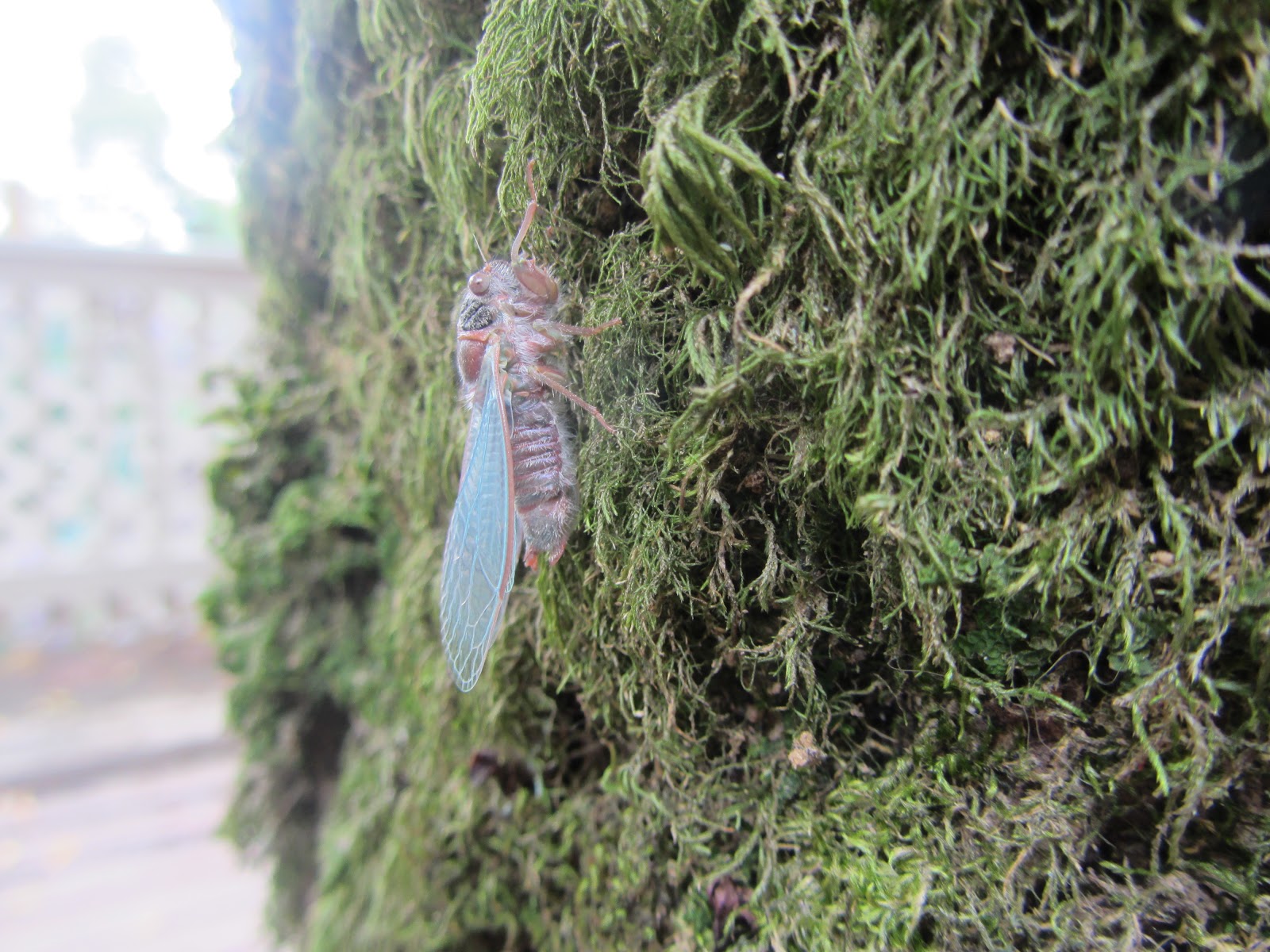
I heard on the radio recently that the east coast is about to be blessed with an abundance of Cicada "by the shovelful".  One brood there is about to reach the point in it's 17-year life cycle where it gets to take wing, and apparently get eaten by everything.  Although I regretfully won't get to see that cornucopia, I was please to get to see our own variety coming to the surface last week.  Although not a shovelful, a very fascinating little critter even solo.

Cicada Nymph Skin

"Fresh" Cicada
Wings More Developed

While we didn't get to see it break out of it's nymph phase case, we saw it right after, as the wings took shape.  It was cruising up the moss to higher on the tree where it broke out.  NPR currently has a great timelapse photo series of one breaking out.

Does anyone have any thoughts on the exact species this is?

Additional Information
http://www.npr.org/blogs/krulwich/2013/04/02/176012068/sing-fly-mate-die-here-come-the-cicadas
http://en.wikipedia.org/wiki/Cicada


Friday, September 7, 2012

Pseudopupil

I learned something yesterday.

Yesterday something that looked, out of the corner of my eye, like a large clumsy moth/grasshopper careened by us and landed unceremoniously and loudly on a jasmine plant.   I went over to investigate and found a large mantis looking back at me.

I say looking back, because as I moved around it taking pictures, it appeared as though it's eyes were following me.  At least it looked like there was a pupil always aimed me, but I couldn't otherwise figure out how it's eyeball would move, and didn't they have compound eyes?

That is when I learned about the pseudopupil!

"In the compound eye of invertebrates such as insects and crustaceans, the pseudopupil appears as a dark spot which moves across the eye as the animal is rotated. This occurs because the ommatidia which one observes "head-on" (along their optical axes) absorb the incident light, while those to one side reflect it. The pseudopupil therefore reveals which ommatidia are aligned with the axis along which the observer is viewing."


I imagine this effect is just more obvious in the mantis, because of the size and color of their eyes.  And their willingness to hold still.  It did also turn it's head to follow my actions, giving the impression of more presence of mind than most insect encounters.

Another interesting factoid from Wikipedia "All S. Californicas have sensors near their legs that allow the praying mantis to lose its head and still function. This is good if the head is devoured during mating."  So much for presence of mind...

This one maybe the native Stagmomantis californica, California Mantis, but possibly the introduced Mantis religiosa - there seems to be a dark spot on the bicep, but I can't tell for sure.  I think it is a he, based on the length of the wings in comparison to the torso (thank you RandomTruth for the guidance on this and species!).  I hope he hangs around and catches some of the horse flies.

References:
http://en.m.wikipedia.org/wiki/Pseudopupil
http://en.wikipedia.org/wiki/Stagmomantis_californica
http://daviswiki.org/mantids

Saturday, August 18, 2012

Mama's boy

The little deer in the last post is growing up,  I think he even has the start of antler buds showing up. 


Although he's still a nursing baby.

Wednesday, May 30, 2012

Spring Babies

It seems like there are little babies starting to come out and about all over these days.

There was the little deer that came by the kitchen about 2 weeks ago.

Then the turkey brought her flock of poults by for some foraging.  


Then the lone duckling catching the first morning sun with it's mother.


Then the young turtle basking on a log (about the size of two silver dollars).


The froglets, many still with their tadpole tail
For size reference, these are a child's hands
Then just today, the Chickadee fledgling getting fed by it's attentive parents in the front yard.


Sunday, May 6, 2012

Hawk Spa

One of the great things about camera traps, is the glimpse into the behavior of wildlife when they are quite sure no one is watching.

I know that birds take baths, many of us have just fantastic bird baths to encourage this!  However, it seems that passerines are a bit less shy than raptors about bathing in public.  I never had the honor of seeing a hawk take a bath before I checked the cams last week.


This bird took it's sweet time in the creek.  From the time it first triggered the camera, until it flew off, it was in the water about 20 minutes, just before 10am.  That water is really chilly, it is in a nice shady riparian area.  It seems like it was moving in nice and slowly, getting it's toes and tail feathers used the the water, before going in for the full plunge.

The rest of the videos from this set are from wood ducks, floating upstream and downstream in front of the camera, and repeating, and repeating.  At least they are very pretty birds!  Hopefully we'll see them with babies in a couple months.


Nature Blog Network